abby henrich
  • Journey
  • Spirit
  • Practical
  • Community
  • About
  • Contact
  • Where

In America, we like nice girls, not angry women.

2/27/2020

0 Comments

 
Picture
I was taught to be a nice girl. You know, nice and polite and quiet. It didn’t stick, thank God.

I’m connected, but not nice. I genuinely care about the people in my life. I pray for people in checkout lines while I wait. Really. I’ll also tell the people in my life the hard truth, like they need to end that broken relationship. Nice is surface. Connection is deep. 

Polite isn’t my gig. Caring is. I’ll show up at your house with dinner after you’ve had a baby, tell you all the gruesome facts about postpartum, laugh with you, cry with you, and go out to purchase you some hemorrhoid spray if you need it. Ms. Manners would have me leave a nice note with food at the door. This full postpartum disclosure is definitely not polite by my mother’s standards. I talk about everything, mixed company or not. By the way, what is mixed company nowadays, anyhow?

I AM NOT QUIET.  Outspoken? Without question. I am usually the loudest person in a room. I’m a preacher for goodness sakes! Stop telling me to be quiet unless someone is sleeping. 

I could have been that nice girl, maybe, but nice was too small and tidy a cage. I tried occasionally to fit my big personality into that cage, but it never fit. It always burst out. .

***
Nancy Pelosi was probably taught to be a nice girl too. Yes, she grew up attending political rallies and learning the importance of social justice. Yet as the youngest of seven and the only daughter, who attended an all girls Catholic school, I’m certain she was exposed to the cult of nice. 

Ripping up Trump’s state of the union speech on prime time TV was not “nice.” It was not polite. Ironically, it was a very quiet LOUD action. 

It was angry. 

Here are some facts (not alternative facts, but real facts): 
  • Nancy Pelosi is the highest-ranking female elected official in United States history.
  • As Speaker of the House, she is second in the presidential line of succession, immediately after the vice president.
  • Trump publicly mocked a reporter with a disability. This was not nice or polite.
  • Trump is a man. Nancy Pelosi is a woman.
  • Nancy Pelosi attacked one person by ripping up his speech: the President. She did not attack an entire group of people by subjecting them to name calling as Trump often does. Do you remember when he started his Presidential campaign by calling Mexican immigrants rapists? https://time.com/4473972/donald-trump-mexico-meeting-insult/
  • Rush Limbaugh received the Presidential Medal of Freedom that same evening. Limbaugh has publically called women sluts, mocked Asian speaking people, used the N word all on his radio show. He would be fired from most workplaces for his conduct. Limbaugh is not nice or polite. https://www.nytimes.com/2020/02/07/sunday-review/rush-limbaugh-trump-medal.html
  • It is not illegal to tear up the state of the union speech.

Trump and Limbaugh rip up humans. Nancy Pelosi ripped up a speech. That’s it. Her anger was contained. She was silent. She did not interrupt the state of the union. 

Nevertheless, her actions were labeled as childish, bitter, and classless by the same people who have embraced the hateful speech of the man who holds the highest office in the nation. Is this because they are hypocrites? Clearly. But it’s also because as a culture we do not tolerate angry women. 

Why are we not applauding Nancy Pelosi for keeping her anger in check for as long as she did in this hateful new political landscape? How did she keep from screaming against a bigot who practices cruel, sexism, racism, and nationalism? 

We should applaud her for appropriately and publicly revealing her anger toward not only a president, but also a senate that has embraced a corrupt president. If she were a man we would have applauded her. Men are allowed to prophesy, angrily. If Nancy Pelosi had a penis, she would have been celebrated as a powerful leader instead of a childish, bitter woman. But Nancy Pelosi isn’t bitter at men, she’s angry at injustice. And she should be. Jesus wants her to be.

We just don’t know how to handle anger in those we have deemed inhuman and undeserving: people of color, women, LGBTQ+, immigrants, and others. White men, on the other hand, are allowed to be angry. You need look no further than Brett Kavanaugh’s rage or Lindsey Graham's theatrics during the  confirmation hearings. There is also the POTUS who tweetstorms his fury daily. But Nancy Pelosi’s controlled, visible anger at the State of the Union riled the patriarchy because America can’t make room for women’s unabashed anger in our chauvinist culture. America likes 
nice girls, not powerful, bold women who show up ready to fight. 

***
Like Nancy, as a deeply connected christian, I cannot ignore the plight of others. Whole groups of people in our country are struggling with basic human rights such as health care, food, shelter, and education, due to the inhumane policies of our current administration. Nice can turn away from their suffering, but Nancy can’t, and I can’t. As a minister confronted daily with the needs of the least of God’s children, during an administration that dismisses and often mocks God’s beloved people, my anger rightfully rises. It rises because I am a disciple of Jesus. May yours rise as well.

0 Comments

Restorative Justice & #MeToo

2/12/2020

0 Comments

 
Picture
My high school dean silenced me as a 17 year old girl with the exact words, “We already know what you think.” I had gathered a group of female classmates to tell her that the physics teacher was raping our classmate. She was annoyed with me, troublemaker that I am. You can learn more of my story in this blog. When the truth of my allegations came out 30 years later, after an extensive investigation by a law firm, she lost her job at my high school. There had been a culture of abuse, the law firm determined, and the dean had been complicit, so the school let her go.abbyhenrich.weebly.com/community/archives/10-2017 

She was immediately hired at a prestigious college. 

What is the way forward after #MeToo? Should my dean’s career be ruined indefinitely for what she said to me 25 years ago and for her complicity in a culture of abuse and her willful denial? Or should she be forgiven and allowed to continue her work in education? These questions are important: How we heal as individuals and as a society is the significant work before us in this new #MeToo world.  

Let me begin by telling you what is NOT helpful in this healing process:
  • “You need to move on.” No joke. I wish I could. I have longed to leave Nichols behind me since I graduated over 25 years ago, but it has not been possible. Trauma leaves an imprint on your brain that you cannot simply leave behind. I’m working on it. Truly. But it is not as easy as deciding I’m done with that chapter in my life. It still haunts me in very unhealthy ways.
  • “You need to work on forgiveness.” As someone who has devoted my life to following a guy named Jesus, I am fully committed to forgiveness. Forgiveness is a process that involves two parties. No one has yet said I am sorry. No one. Not one teacher or administrator who was involved has said, “I am sorry.” That makes it a lot harder to forgive.
  • “Things are better now.” “It’s a different place.” Yes, I think things are better for my youth and my kids in 2020. I even believe that the culture at my high school has changed. I think we can be proud of that progress without ignoring the very real traumatic experiences of the past. There is a way forward without denying the past. 

What IS helpful? I can only answer this question from my very individual perspective. 

Recently I have been learning about restorative justice as an alternative to our criminal justice system. At the heart of restorative justice is the involvement of the victim. If someone were to ask me what would restore justice to me after the #MeToo experience I endured at Nichols, I believe I have a clear answer:

  • My dean and the upper school headmaster at the time, would sit down with me. I’m not sure who else I would need in the room. My guess would be my beloved husband or maybe my bff from Nichols, Leila. If they needed their lawyers, they could come, but I would prefer no lawyers. If they needed assurance that everything was off the record, I would gladly grant that to them. I would want them to hear from me the pain they caused me, the impact they have had on my life. 
  • I also need them to say “I am sorry.” Just “I am sorry.” Period. To that I promise you I would gladly say, “I forgive you,” and mean it. How else could we possibly move forward without those words spoken?
  • Would I want money for my therapy co-pays? I don’t think so, but maybe I would want some money to be given to a nonprofit that supports victims of sexual abuse. But how would I come up with a dollar figure? I have no clear answer to this question. I mention this only because many people seek real financial restorative justice. This makes sense to me. I am not morally superior to these victims; I am simply financially secure. 

That’s it. Face to face listening and an apology. From my perspective this is a simple request. Would it be emotionally exhausting? Yes. Would they be incredibly brave to do it? Yes. Without question. Would it be worth it? I deeply believe it would be. There is no way forward without reconciliation. Reconciliation takes telling and listening. It takes acknowledging pain, asking for forgiveness and offering forgiveness.  It takes facing the past together and looking forward to a future. It takes collectively struggling for a new way. 

I also wonder if I were to come face to face with my dean and headmaster, if we could grieve together for the people we were, trapped in a terrible system. They might have been as trapped as I was and in need of just as much healing.  I refuse to accept that they are morally bankrupt humans. Instead, I would guess that both are deeply troubled by what happened and desire a way forward.

If I were granted an opportunity for restorative justice with my dean, how would that change my perception of her new position? If she was brave enough to engage with me in authentic conversation and listen with an open heart to my story, I would speak positively about her new beginning. I would remind others that we cannot judge someone solely on their past, and that together, as a community, we must move forward into this new #MeToo world bravely and honestly. Only this way can we create a world where everyone is safe.

This is the work of our community. It is not the work of an individual alone in therapy who is told too often to forgive, move on, and get over it. I do not know how this can happen without reconciliation. As the victim, I feel powerless. I am too aware that some do not want to hear me call myself a victim nor admit that I feel powerless, but there it is, my truth.  I am too worn out to do anymore of this work on my own. 

Who will the champion be?

0 Comments

Social Capital, Food Pantry, and the Manger

12/19/2019

0 Comments

 
Picture
It’s Christmas time. Everyone wants a tender story of goodwill. I could share one of those stories with you. I have at least ten. I could tell you how the outpouring of new coats filled my office so that I couldn’t even walk to my closet; we delivered over 60 coats to low income children at the Chittick School. I could tell you about the bags filled with good things for children who have nothing to eat delivered to my house daily. I could tell you about the two brand new bikes in the church parlor waiting to be delivered to children who would otherwise have nothing to open on Christmas day. I could even tell you about the breakfast spread for hard working teachers that folks with no connection to the school made happen because that is what staff at a school deserve. 

Instead I am going to tell you two stories that might leave you heartbroken, maybe hopeful, and awake to the power of social capital.

Story one:
Yesterday was food pantry day at Rose’s Bounty at the Stratford Street Church where I am pastor. Running a food pantry is exhausting, complicated, and a bit like managing utter chaos. A little girl was waiting outside with her mother. Wisely, the mother had her daughter wait just inside the door out of the cold. While walking to my office I discovered this sweet child, waiting patiently. 

She was warmly dressed and quiet. I asked her if her mom was outside. She looked at me with wide eyes. I then asked her if she would like a drink. No response, but an earnest wide-eyed look. I fetched her a juice box and raisins. She responded to my meager gift, “Gracias.” Manners and patience she had in abundance,  and only Spanish. But why wasn’t she in school? She was old enough.

Our Spanish speaking volunteer and client, Jamie, was the person to help. Before the commotion started, I recruited Jamie to help me speak with the parent so we could enroll this wide eyed child in school. Jamie didn’t forget. In the middle of the chaos, he found the mom and brought her to me, ready to translate. To our surprise, the mother spoke perfect English. How was this possible? 

In the middle of a hundred plus people shopping for food, I learned her story.

She is Venezuelan. She lived in the U.S. for sometime as a child which is why her English was perfect. She returned to Venezuela with her family before high school, but the grinding poverty and political unrest was too much. Fortunately, she was able to escape, and she was able to bring her daughter. Tears rose in her eyes, falling silently as she gripped the pink jacket enfolding her daughter in warmth. The daughter watched as we cried. Her daughter wasn’t in school because she didn’t want to lose her. What if ICE found her in school? What if the teachers reported her?  What if she was deported? 

I have social capital: I am a well educated, rich white woman AND a pastor. Somehow when the poor discover I am a pastor they immediately trust me. I only have to utter the words “I am a minister” and faces relax, language slows, and always there is an exhale.  I assured this desperate mom that all children, regardless of their housing situation, citizenship status, or language, can attend school in Boston. Quickly she shared this news with her daughter whose little face lit up. She could go to school. I grabbed that mother’s hands and assured her that her daughter would not be taken from her, that they were safe, that they would survive, and then I cried with her.

I’m not sure if I cried from joy or because I knew I wasn’t telling the whole truth. I do believe that in Boston, with the right precautions, you are relatively safe as an undocumented immigrant, especially in the school system. Yet before me was a loving mother who had risked everything to escape grinding poverty in Venezuela, but in America was terrified to send her child to school. What kind of world do we live in?

Later today I received a text from the mother, “You have been an angel for my daughter and me that I cannot put into words. Thank you, thank you. Bless you this Christmas.” I am no angel. I am just a privileged woman who knows the federal law: public schools may not ask about a child’s immigration status, Plyler vs. Doe (457 U.S. 202 (1982)). 

Story two:
We had a new client at the food pantry today. She saw we had children’s coats and asked if she could look through them for her son. Of course, we told her. She found me outside later, shoveling the walkway. She wanted to make sure she thanked me for the help. Then she asked, “Do you have another shovel?” I insisted she didn’t need to help me. “Go home and unpack your groceries.” “I feel bad,” she told  me. “What for?” I asked. “Because I don’t want you shoveling alone.” I retrieved the other snow shovel. 

We talked while we shoveled. I found out this tall woman was not only a mom but a college graduate. Where from I asked? Northeastern. She is also an immigrant. She is also the first person in her family to graduate from college. Her career  derailed when her young son started having seizures and her young brother died. She had to leave work to care for her son and her depression was overwhelming after her brother’s death. She was homeless for over a year, but she moved into section eight housing in August. Her son is doing so much better since they have been living in permanent housing. Once, she had dreamed of going to law school. Now, she is hopeful that she is back on track. 

If my son had seizures, my job would give me time off. If I was deeply depressed my family would take care of me, as my in-laws did when they moved in for three weeks while I had postpartum depression. I would never be homeless. I know so many people with extra rooms, extra houses (!), and extra bank accounts. I would be fine. It would be hard, but I would be fine. My life trajectory might be paused, but never derailed. 

Social Capital:
Social Capital is difficult to measure. I know I have a lot, but yesterdayI learned I have even more social capital than I realized. I knew a wide-eyed child could go to school and my life wasn’t derailed by postpartum depression because I am: 

Picture
  • Educated
  • White
  • Native-born
  • English-speaking
  • Documented
  • Descended from educated people
  • Friends with influential people
  • English speaking
  • Healthy
  • Insured
  • The mother of healthy children
  • Married to someone with social capital
  • A salaried professional with benefits
  • More I am sure can be added to this list.

Mary and Joseph had very little social capital. They were homeless migrants, and later immigrants when they fled Herod’s violent rule. No relatives in Bethlehem  would take them into their homes (remember Bethlehem was Joseph’s hometown). As far as we know they were uneducated peasants. The miracle of Christmas is this: it was to these two people first, and then to all of us, that the Prince of Peace, the Savior, was born. Emmanuel. God with us. Social capital did not enter into God’s Emmanuel equation. 

This Christmas, let us remember the story of a child born to parents with no social capital. Let us remember that God first came to them. Today, let us be reassured that God is first with the Venezuelan mother and her daughter and the homeless college graduate and her son. The story of Christmas is not a story of cheap charity. The story of Christmas is the of a God who accompanies those who are the least, the last, the forgotten. If we trust in this God, then social capital can no longer be the yardstick by which we measure an individual’s worth. In God’s eyes, we are all infinitely valuable. ​
Picture
0 Comments

This is NOT a JOKE: White Men Must Now Earn My Respect.

10/18/2018

1 Comment

 
Picture
This is not a joke.

The following people walk into a coffee shop:
A white man, well dressed and handsome. Ivy League educated.
A black man in a hoodie.
A punked out teenage girl with dreads.
A female jewish rabbi with a brush cut.
A gorgeous Brazilian woman (This is my stereotype. I’ve yet to meet a Brazilian woman who is not gorgeous).
A white teenage girl, nondescript, shy.
A white teenage boy, nondescript.
A Hispanic teenage boy wearing a football jersey.
An imam (Muslim minister), wearing his clerical dress.
A six foot-two transgendered woman.
A white female minister who is a rabid feminist (yes that’s me).

Who is likely to kill everyone in the coffee shop with a gun? Yep, one of the white men. Statistically, when it comes to mass murder in America, white men are disproportionately  responsible. You can read proof of this assertion here.

Who is most likely to be a sexual assailant? I don’t think I need to even answer that one for you, but just in case you are confused: any man in the coffee shop. Any man could assault any woman. This DOES NOT mean all the men will, or any man will. Yet we cannot ignore that 1 in 3 women in America are sexually assaulted or raped by a man in their lifetime. Who could be sexually assaulted? Any woman in the coffee shop. Any woman. Sexual assault has nothing to do with looks. It has to do with power. Predators often prey upon the “nondescript shy girl” because she seems the least powerful. In addition, the teenage boy could be assaulted due to his less powerful position. Transgender and queer folks report an even higher percentage of sexual assault than straight women. Let that sink in.

Who is likely to start a physical fight? The Rabbi and Imam? Nope. In fact, if they are working hard for peace like many religious leaders in this country, they might be really pleased to find themselves in a coffee shop together, the common cup of java between them. After what we saw during Brett Kavanagh’s confirmation hearing, I would venture to guess in this America First Culture that the most likely person to start a fight is the ivy-league-educated, well dressed white man. Especially if he’s had some beer, because he really likes beer. He might become really angry when he discovers he can’t be the first in line, or that his barista doesn’t speak perfect English, or that the man with the hoodie needs to use the bathroom. Who knows, maybe he’ll be really belligerent when he discovers that it’s a coffee house, not a bar, with no  beer on tap. Because you know, he really likes beer. And he’ll certainly think it is his prerogative to interrupt and belittle you whenever he gets the chance because he has always been in power. Always. He has no idea there is any other way to act because all of his life everyone has listened, cleared the way, and honored his power.

If I were in that coffee shop, I would be most afraid of the white man.

Hopefully, in my recent I-am-so-angry state, I wouldn’t pick a fight with him.

****

Everything I just wrote is hypothetical. It relies heavily on stereotypes, assumes many things, and places everyone in simplified categories. But it also makes a point, doesn’t it?

The “old bulls,” as Dan Rather named them, have been in control from the beginning of this country’s inception. They don’t want to lose their power, so they are spinning alternative realities to match alternative facts that attest they are the ones oppressed. They are not going to give up their power without an epic battle.  That’s why, after the Kavanaugh hearings, Republicans reported a spike in contributions. That is also why they are crying wolf.

The old bulls are unwilling to look seriously at how power has eaten away at their moral center. Yet some white men are willing to converse, are willing to consider the painful stereotypes I imagined in the coffee shop.

But are they truly white men, if they are willing to move beyond their tribal identity and join the rest of our melting pot beauty, where we all enter a coffee shop on equal footing?  

****

Picture
After Kavanaugh's hearing, it has became apparent to me that the old bulls are unwilling to look critically at their behavior or the way that power and privilege has corrupted their souls.

In response, I have developed a new personal strategy: White men can no longer assume my respect; they must earn it. Everytime.

Everytime.

Imagine if white men had to earn our respect instead of assuming they already have it? Suppose they had to serve their way into responsibility, instead of ruling their way into power?

I’m serious.

Think about it.

What if when that well dressed, Ivy league educated white man walked into the coffee house, he worked hard to win everyone’s respect? What if he was gracious, patient, and engaged with his community around him? What if he gave a large tip to the barista since he makes the most money? (BTW, men do tend to be better tippers than women). What if he let the quiet shy girl cut in front of him? What if he talked about “the game” or even the weather or the coffee with everyone else in line or at tables, especially those folks around him who have been inculturated to feel like his subordinate? What would happen then?

****

As a young, female minister, I had to earn the respect of my male colleagues and the congregations I served. This was sometimes unjust and other times appropriate.

As a twenty five year old candidate for ordination I had to answer questions my male colleagues didn’t: How do you plan on being a mother and pastor? I also had to endure critiques about my high voice (give me a break) and misplaced guidance about how as a young woman I should really be an associate pastor for families and youth (spare me). I even had to manage my looks: What should I wear on a Sunday morning under that robe? Thank you for your well wishes, but no, you can’t tell me you like my legs(!). This balancing act, always wondering just what I could say and how I could act in a way still authentic to myself, while also winning the approval of those who granted me my authority was exhausting. I am certain my male white colleagues were not under such pressure.

Appropriately, as a newly ordained minister, I also had to earn my stripes. This took thoughtful and meaningful attention to my job. With each interaction, I earned my beloved parishioners trust as I visited in hospitals, taught confirmation classes, showed up at fall clean up day, and preached. This earnest attention, although at times exhausting, was also life giving. I was living into my call as a pastor. I misstepped, soared, learned, changed, goofed, and grew. In the end, I earned my stripes, solely because the majority of people I served respected me as their pastor and trusted me as a person.

I do not, and will never, take this respect lightly. In fact, it is an abiding blessing that sustains me in my work. Just as I am certain my male colleagues never had to pay attention to their clothes nor answer questions about the pitch of their voice, I am also certain, like me, they had to earn the trust and respect of their congregations. I have a hunch it was easier for them. They wore suits on Sunday. Their voices were naturally deeper. They had potential, whereas I was a wild card. But still, I know my dear male colleagues worked hard to earn their stripes too. I have many “white male” colleagues whom I deeply admire and know for a fact worked hard to shed stereotypes about “male ministers” that often created harmful barriers between themselves and their congregations.

****
What if white men, like every young female on the planet,  had to earn our respect first instead of stampeding through our common spaces like the old bulls they are? What if they saw themselves not as entitled to power, but instead as one of many called to share in the creation of a just and equal society? What if they had to, like I had to as a young minister, earn the trust and respect of others with whom they shared this country?

For this angry female minister, it’s over. You old bulls don’t automatically have my respect any longer. You have to earn it. So start working. And if you don’t care, that’s okay. We will be voting you out. We will stop buying from your companies, because there are more of us than there are of you. You are OLD bulls. A whole new herd is moving in.

If you do care, welcome to this beautiful community called America. Because here, in the real America, we, all of us--men, women, white, black, brown, gay, straight, religious, atheist, rich, poor, LGBTQ+, straight, educated or not--together, we are building a democracy.


1 Comment

You Haven't Listened!

9/21/2018

1 Comment

 
Picture
Before the #metoo movement became defined with a hashtag, I found myself in the throws of an intense sexual abuse investigation. With an open letter to the Board of Trustees at our high school, my childhood friend, Liza, and I forced our alma mater to look deep into its past and its current culture regarding sexual abuse. The incident we brought to their attention occurred over twenty years prior to our letter, but it was as raw to us as when we were 17 year old girl-women. Although I was not the abused, but rather the “defender” of my abused friend, Liza and I share this story intimately. Our roles and experiences are different, but we were both victims of a culture that ignored sexual abuse. The investigation we triggered was simultaneously healing and difficult. You can read the blog I wrote about this almost cliche sexual abuse story of institutional preservation, male power, and female silencing.


When the news broke this week about Professor Christine Blasey Ford’s story of survival and courage, my experience confronting my alma mater came crashing back. Each news story, each detailed article incessantly picked at my #metoo wound. I was pleased to discover that my wound is mostly healed, but I could not ignore the connections. I could not ignore the anger that rose from deep within.  I also could not ignore how defeated I felt. How many times will I have to listen to commentators ask, “Why is she telling her story now?” or “It happened 30 years ago. How can she be sure?”

Let me offer “you” some answers, “you” being the emotionally-bankrupt-head-in-the-sand politicians who ask such ignorant questions! Or as the Hawaii Sen Mazie Hirono said, “Shut up and Step Up!” But in my case I want you to Shut Up and Listen Up. Professor Ford is confronting a country. I only confronted a school. Imagine her courage. She has nothing to gain! Nor did I.

Why is she telling her story now?
Um, isn’t that obvious? Because Brett Kavanaugh has been nominated to the Supreme Court. Professor Ford is a patriot for sacrificing her privacy for the good of our country.

If you need a more nuanced answer: Christine Blasely Ford did tell her story earlier to her husband, therapist and probably many others. Women have been telling our stories of sexual abuse for centuries, but we have been silenced. For many of us our silencing has been covert. We’ve been silenced by our culture everytime we hear, “Boys will be boys” or my personal favorite, “It was just locker room talk.” We’ve been silenced when our mothers told us never to find ourselves in a room alone with a boy, because whatever happens after would be our fault. We’ve been silenced by our fellow classmates who heard the rumors about what happened and lowered their heads in shame, unable to look at us . . . as if we were at fault. We’ve been silenced by every comment that insinuates the way we dress, the way we act, the way we look, “asks for it.” We have been silenced by our sexual partners who didn’t want the past to inconveniently interrupt their pleasure.

I am confident that Professor Ford told a handful of people her story about the bathing suit that saved her. In fact, I am positive everytime she found herself struggling to take off a one piece bathing suit in a bathroom stall, she murmured a silent thanks. I can imagine the telling of her story, piece by piece, that has moved her from a place of shame and fear to a new place of survival and healing.

She has told her story. Now she is telling it again.

We have all told our stories before.


YOU HAVEN’T LISTENED.

I told my my headmaster twice that my friend was being abused by a teacher. He didn’t listen and worse, he didn’t care. I then told my dean and she told me to be quiet. Her words, “Abby, we already know what you think. Be quiet!” echo in my psyche.

Stop asking why we’ve never spoken up before. We have. You haven’t listened. And just to be clear, we get to share our stories of abuse and survival whenever we want. They belong to us. Not you.

How can she be sure what happened 30 years ago?

Scientists have proven that traumatic experiences leave a signature in the brain that is hard to erase. I can attest to this truth.

I can tell you where all my classrooms were located in my high school, my teachers’ names, and more. I have a very good memory. I could not tell you, however, the color of the walls, where each teacher placed book shelves or desks. I could only guess.

But I can tell you every detail of my dean’s office. I can tell you every detail of the meeting, where a group of other students and I went to seek help for our classmate who was being abused.  I can tell you where I sat in that small room and where the dean first sat, and then stood, leaning against her desk. I can remember the hesitant, almost stalling voices of my classmates, too afraid to say the word, “sex.”  I know now that my memory is so clear because the experience was traumatic. I’ve carried this moment with me for years in technicolor, and I can hear my dean’s voice, “Abby, we already know what you think. Be quiet!”  

I am not surprised that Professor Ford can remember the sequence of events during that particular high school party: the two drunks boys pushing her into a deserted room, the struggle, the bathing suit, the hand over her mouth, the tumble, and her escape.

Years do not erase the memory of trauma. If only they did. When such memories are buried by the psyche so the victim can survive, they always return to haunt their hosts. In my work as a pastor I can’t tell you the number of times I have borne witness to women in the throws of terrible depressions who discover they have buried memories of sexual abuse. I have seen the scars on teenage girls’ arms after they have cut themselves because it was the only way they could dull the repressed memory-pain of sexual abuse. I have listened to a 60 year old woman tell of her father’s daily rape that she had blocked from her memory until she finally felt safe after his death.

Professor Ford has a story to tell. She remembers this story too vividly. Sexual abuse will never stop until we listen and believe. She is telling this story again with clarity and courage because it matters to the future of our country. It also matters to the many women who are still hiding their #metoo stories. Telling and listening is the only way as a nation we can heal and move forward into a new way of living as sexual beings of all gendered identities who never accept abuse as the norm.

#MeToo #UsToo #AllofUs


1 Comment

Following Jesus = love and righteous anger

6/27/2018

0 Comments


“Returning hate for hate multiplies hate, adding deeper
​darkness to a night already devoid of stars.” --MLK

Picture
I’m a hateful person. Really, I am. I love to feed my anger. I have done awful, embarrassing things while I have been angry. I once almost keyed a car until my rational side kicked in (that rational side only having to do with jail, not some moral high ground). I won’t tell you what else I’ve done. It’s too shameful.

I am also a follower of Jesus. And that guy has a lot to say about retributive justice, forgiveness, and love. He also has a lot to say about how we treat the poor and most vulnerable.

Since I decided at 18 to seriously follow Jesus, I have been doggedly working on my anger. I’m still naturally an angry, hate-holding-on-to sort of person. Yet I have made progress as I have sought to increase the love I receive and share in the world. Love has always been the best antidote to hate.

Along with this surge of love, however, there has also been a surge of righteous anger. As I have opened myself to love, I have become increasingly vulnerable to those whom Jesus calls the least. This vulnerable love has ignited my righteous, God-rooted anger. It is this anger that has pushed me to write checks, carried me to protests, opened my heart to painful stories, called me to eat meals with the homeless, and in my less that sterling moments released strings of obscenities as I read the latest news.

One of my great spiritual heroes, Martin Luther King, Jr., proved through his life work why Jesus had it right. Retributive justice doesn’t work. Answering violence with violence changes nothing. But still, like MLK, I am righteously angry, especially these days as I watch children indefinitely separated from their parents. And not just any children, but poor refugee children who have seen horrible trauma in their life before they even entered the U.S.  These, the least of God’s children, are in detention centers, sleeping on floors under silver blankets. God have mercy.  

So what do I think about Maxine Waters? I think she is probably like me. I think she is righteously angry. I think she shouldn’t have responded to hate with hate, adding deeper darkness to a night already devoid of stars. I think Michelle Obama is right: when they go low, we must go high. But still, I understand. I recognize that anger. She did what Jesus commanded her to do-- fight for the least. She did what our democracy demands us to do-- protest injustice.

Maxine Waters also didn’t tell anyone to use violence. She encouraged the crowd to push back, to “create a crowd,” to protest wherever supporters of Trump’s separation of children happen to be. That said, she teetered on a thin branch that bent too far toward anger, and not enough toward justice. Sadly,  not much good was accomplished through her righteous anger, since it was unchecked by love.

Picture
But this isn’t really what troubles me. We disciples are always imperfect, always stumbling, always carrying our baggage of human hurt. Maxine Waters is imperfect like the rest of us. What mystifies me is our nation’s timing: Why now are we offended that a politician has unleashed her anger? Why did Paul Ryan call on Maxine Waters to apologize, but not President Trump, who started his Presidential campaign by calling Mexicans rapists? I cannot make sense of any of this.

  • Does President Trump get to say anything he wants because he is a white man?
  • Are we angry with Maxine Waters for speaking her mind because black women are still not supposed to speak up in America?
  • Does President Trump receive a pass on his vile descriptions of whole classes of people because he is talking about the least-- the poor, the brown, the immigrant, the forgotten, the vulnerable?
  • Why has no one pointed out what Trump tweeted after Maxine Water’s speech? Congresswoman Maxine Waters, an extraordinarily low IQ person, has become, together with Nancy Pelosi, the Face of the Democrat Party. She has just called for harm to supporters, of which there are many, of the Make America Great Again movement. Be careful what you wish for Max! Is his name calling and suggestion of retributive violence different because it was tweeted, not passionately delivered at a rally?
  • Are so many white and Christian men on my FB coming out to express their disapproval of Maxine Water’s words, but not Trump’s, because they feel threatened?  Why have they been silent about Trump’s hate?

We will not learn from this moment in history if we simply point a finger at a black woman for letting her righteous anger go unchecked. This moment is about race, about gender, about injustice, and about power. We must engage in a larger conversation.

I’m righteously angry. My anger is rooted deeply in the teachings of Jesus. That anger will carry me to the Boston City Hall Plaza on Saturday. (Learn more.) Yet, most of the time, my anger has arisen from love. I am angry because I love the least of God’s children. Currently, they are refugee children separated from their parents, sleeping under silver blankets,  instead of being safe in bed, in the arms of their family.

0 Comments

Florida House Approves Bill to Post In God We Trust signs in all public schools

2/22/2018

0 Comments

 
Picture
And now this:
Florida lawmakers rejected a motion to bring an assault weapons ban to a vote Tuesday. Guess what they did do: the Florida House approved a bill to post In God We Trust signs in all public schools. I am utterly confused. Utterly.

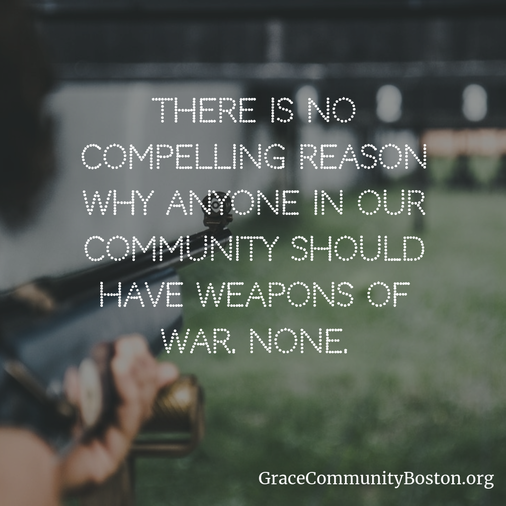
At Grace (Community Boston) we are a committed group of Jesus followers. Since Sandy Hook we’ve been desperately advocating for common sense gun laws and banning assault weapons. We’ve created public awareness campaigns (like the one we are doing now. Lawn signs. If you are in the Boston area and would like one, ping me), written letters, and made it clear to everyone and anyone who would listen that Gun Violence is a christian justice issue! At Grace we are not advocating for a ban on assault weapons because we are a bunch of hippie freak Massachusetts liberals. We are advocating for a ban because we are Christians.

And now this? The Florida legislature thinks remaining silent on an assault weapons ban, but putting up signs about God every where is the Christian Response?!  I have some really choice expletives for you weak, wimpy, Jesus posers. Cowards. Read your bible!

I wrote the following in a blog dated from 11/9/17:

As a follower of Jesus, I believe the American Christian Church is a sponsor of terrorism for remaining deafeningly quiet on gun control. The Christian Church has loudly declared its concerns over unborn fetuses and led a successful campaign to limit women’s access to safe and affordable abortions. I am confident that the Church could lead as a successful campaign to mandate common sense gun control, but it hasn’t. In remaining quiet, the Christian Church has made it clear that the deaths of thousands are unimportant. Domestic terrorism is acceptable. And in doing so they embraced the irony that elementary students in Sandy Hook, CT matter less than unwanted fetuses.
​
As Christians, we cannot stay quiet. We must mobilize, less we become the church of guns. Signs in schools reminding students to trust God is the very definition of faith without works. If you want to follow Jesus, join the fight for gun control and pray with your vote. A sign will make no difference. If anything a trust God sign will make it clear to the students that we do not care.

#banassaultweaponsnow
#endgunviolencenow
#enough
#neveragain
#commonsensegunlaws

0 Comments

New Years & SUMMITS & maybe just community is what we need...

1/17/2018

0 Comments

 
Picture
It's the New Year. A fresh start. We make resolutions. We feel empowered to change our lives. We can create new selves. But what kind of new selves do we want to be?

With the coming of the new year we are bombarded with conflicting advice about just what new path we should take. On one hand our news feeds are filled with ways to become more spiritually centered and balanced. Yet in one click the next newsfeed entices us with promises of sleek bodies, corporate success, and filled closets. (If your closets are already filled, there is another new year’s promise regarding organization and simplification. Or a new home with a bigger closet.)

These seductive promises are schizophrenic and also incredibly ironic. We are living in a moment of history with the lowest participation in faith community and the largest waist lines. Ours newsfeeds know for what we yearn: spirituality and healthier bodies.
 
***

A year ago I saved an advertisement I received in the mail. It was a glossy invitation to attend the “Ultimate Wealth Summit.” Tom Brady was a featured speaker. Just what is an ultimate wealth summit? And why is it a summit instead of a conference? My guess is that summit sounds bigger or more important somehow. It made me laugh. And sorry Patriots fans, but what does Tom Brady have to teach me? I can't throw a football and I don’t want to. Sure he’s got some self-discipline, but from my vantage point, a man with an incredibly abnormal talent does not have much to teach me about success.

But I digress.

Here’s the best part about this SUMMIT. They had a congress of “National Achievers.” I couldn’t figure out from their website just what made the members of this congress national achievers, but I was pretty certain it had something to do with their bank accounts. They promised to teach attendees how to raise “the essential capital to fund your passion,” “multiply their income,” and create “a systemised wealth plan.” These were only steps to the ultimate goal: enjoying life. Which is apparently impossible without gobs of money.

I need to stop writing here so I can gag.

***

As I was pursuing pinterest, searching the best advice on just how to obtain that sleek body I most intensely yearn for after my Christmas butter consumption, somehow the wealth summit snuck into my feed. It promised a new year. A new path to wealth. Prestige. Esteem. Everything I had sought after achieved. Maybe if I attended, I too could be a member of the congress of national achievers.

Clearly, the pin didn’t seduce me, even if I would love to be wealthy and a nationally recognized achiever. Yet this string of thoughts made me question our national obsession with New Year’s itself and collective dreams of being more spiritually centered, successful, balanced, organized, skinnier, wealthier  . . . What if instead this year I didn’t seek after any promise? What if this year instead I gathered with regular old folks at a home, not a summit, and we decided we would be community? What if we decided we didn’t need to create a congress of national achievers, or a seven point plan on how to become that thing--wealthier, skinnier, better-- and instead we supported one another in our earnest, faith-filled, stumbling endeavors to be kinder? And then I remembered: I already do that! My New Year’s resolution is complete. I just need to continue to gather with the folks at Grace and Stratford Street. They expect nothing of me. They just desire my company, as I desire theirs.

New Year’s can be a good time for assessment--where we are in life, where we’re going, where we would like to go. It can also be an opportunity to assess where all those little voices in our head come from, the voices that tell us we’re not good enough, but that this product can make us better. But wouldn’t it be best, wouldn’t we thrive more, if instead we joined a community that told us we were already good enough? That we were already better than we could possibly imagine, that we were already beloved--by God? That’s what faith communities do. Now, if we can only listen to them, and tune out all the voices that tell us we’re not good enough. Because we are good enough, because God delights in us, right now, as we are.

0 Comments

Is the American Christian Church a Sponsor of Terrorism?

11/9/2017

0 Comments

 
Picture
Please read this if you are a gun owner. 
Please read this if you believe nothing can be done to stop the mass shootings in America. 
Please read this if you are afraid your child will not return from school one day.
Please read this if you have become overwhelmed by the gun debate in our country. 
Please read this if you are afraid. 
Please read this if you are a Christian.

The United States has a sever gun problem.
  • Every day an average of 300 Americans are shot.
  • In 2015 there were 36,252 gun deaths, including 22,018 suicides and 12, 979 homicides, and at least 85,000 injuries.
  • Every day, an average of two women are shot dead by their partners.
  • Nearly 6,000 children are shot every year, a fifth accidently with 1,300 fatalities.
  • Since 1982 there wave been 83 mass shootings (definition of a mass shooting: 4 or more victims in a public space.)
  • Americans make up less than 5% of the global population, but own 42% of the world’s guns.
  • Over the past 50 years more Americans have been killed by guns that in all the wars in our nation’s history.

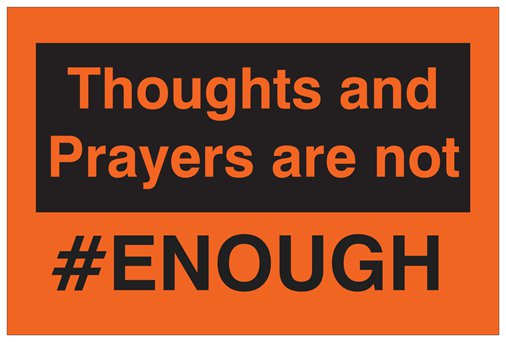
Please do not rationalize away the above stats. Guns are killing American citizens at a horrifying rate. We cannot ignore the recent back to back shootings in Las Vegas or Sutherland Springs, Texas. Thoughts and prayers are empty platitudes. As a Christian minister, I believe America needs policy changes, not prayer.  

Americans are obsessed with safety. If a child falls out of a crib because of a faulty railing, every crib is recalled. Americans are obsessed with health. If we are told that pomegranates are good for us, all of a sudden our supermarkets are filled with pomegranate snacks, juice, treats, infused coffee. So why do we continue to do nothing about guns which are one of the greatest safety and health concerns of this century? Why are we the only western country that watches, inert, as our fellow citizens are slaughtered around us?

There are a number of false rationalizations & complicated rhetoric whirling around gun control, which as of late, have left our country immobile:
  1. Gun control doesn’t work. WRONG: Most of the states with the highest rates of gun deaths, such as Alaska and Louisiana, have loose restrictions; most of those with the lowest rates, such as Hawaii and Massachusetts, have much stricter laws. If we look internationally, the same pattern holds true.
  2. The NRA is a powerful lobbying group. Yes & No. There are more Americans who aren’t members of the NRA. One powerful and wealthy lobbying group cannot hold a country hostage.
  3. The second amendment protects people’s right to bear arms. Yes & No. The Second amendment reads: A well regulated Militia, being necessary to the security of a free State, the right of the people to keep and bear Arms, shall not be infringed. Automatic weapons and militias are very different. In addition, our country has a significant and proud history of changing our constitution: The 13th, 14th, and 15th Amendments ensured equality for recently emancipated slaves; The 19th Amendment granted women the right to vote.
  4. Congress is too divided and can’t get anything done. Yes, but we elected them. They work for us.
  5. It’s a mental health problem. WRONG. I find this argument appalling, as if all mentally ill people are armed and dangerous. Mental Health is not a new disease, but prolific access to semi automatic weapons is. Those who suffer from mental illness are far more likely to be victims of gun violence than the perpetrators.
  6. There is nothing that can be done. WRONG. First, vote! Second, check out these two incredible groups: giffords.org and everytown.org. Third take the time and investiagte all your investmanets, including your pensions. If they are invested in gun manufacturing companies, divest and tell the company/mutual fund/pension board, etc why you are divesting.
    The following is a list of the Biggest Gun Manufacturers in the United States:
  • Sturm Ruger (RGR)
  • Remington Outdoor
  • Smith and Wesson (American Outdoor- AOBC) (SWHC)
  • Glock
  • Sig Sauer
  • O.F. Mossberg and Sons
  • Savage
  • Springfield Armory
  • Beretta
  • Taurus International
  • Keystone Sporting Arms
  • Kahr Arms
  • Barrett Firearms
  • Norinco
  • Hi-Point Firearms

Renee Graham, argued in the Boston Globe (October 8, 2017) that the United States is a state sponsor of terrorism, “Our government is complicit in at least 58 murders and more than 500 injuries at a country music festival in Las Vegas. By failing to consider even common sense gun control policies after previous mass shootings, legislatures are supporting those who terrorize and kill people.” 

I would take Graham’s argument further. As a follower of Jesus, I believe the American Christian Church is a sponsor of terrorism for remaining deafeningly quiet on gun control. The Christian Church has loudly declared its concerns over unborn fetuses and led a successful campaign to limit women’s access to safe and affordable abortions. I am confident that the Church could lead as a successful campaign to mandate common sense gun control, but it hasn’t. In remaining quiet, the Christian Church has made it clear that the deaths of thousands are unimportant. Domestic terrorism is acceptable. And in doing so they embraced the irony that elementary students in Sandy Hook, CT matter less than unwanted fetuses. 

The common Christian response to another mass shooting, "thoughts and prayers," without the will to change policy or practice, is the very definition of "faith without works." As a progressive Christian I’m not praying anymore. As a wise clergy friend said, “...right now I don't have it in me to overwhelm this great empty space with hope-filled murmuring about God’s love and abiding presence in the midst of tragedy.” Instead, I’m acting. I’m speaking the uncomfortable things many do not want to hear. I am voting. And I am pleading with you, if you claim to follow Jesus, to join me in fighting for gun control, and at minimum common sense gun laws. 
​
Read this again: Over the past 50 years more Americans have been killed by guns that in all the wars in our nation’s history.

As Christians, we cannot stay quiet any longer. We must mobilize, less we become the church of guns. 

As citizens, we cannot remain inactive any longer. We must enact real change and policy, less we become a nation of guns.

0 Comments

#MeToo, Yes Me Too. The Story of Two Women

10/19/2017

1 Comment

 
You own everything that happened to you. Tell your stories.
Picture

#MeToo. Yes, me too.

I might not have shared #MeToo on my facebook wall with as much confidence last year. I thought my story of survival didn’t count. In fact, I thought it wasn’t my story, but the story of my childhood friend, Liza. Thanks to her courage and her insight, I have come to understand this is my story, her story, and most powerfully our story.

The story from my point of view is fairly predictable. It is a story of willful institutional preservation and denial, sexual abuse and power, and silencing.  

In the fall of my high school senior year it became apparent to me that my longtime friend, Liza, was in an “abnormal” relationship with a male teacher. I was too young and inexperienced to know what made me uncomfortable about their unusual closeness. I did what I was told to do; I spoke to the head of our school. I told him in detail my concerns, even sharing with him that Liza was spending weekends at the teacher’s home. I heard nothing more. Two weeks later I followed up with the headmaster, still deeply worried for Liza. The headmaster asked me to be patient. Now I understand that asking for patience was his way of telling me to be quiet.

My patience wore out in the late winter. A group of fellow classmates often discussed our growing concern for Liza. We whispered, never naming out loud what we most feared. I was tired of inaction, tired of being “patient” with institutional power. I organized a group of female classmates who shared my concerns and we went to speak to our dean. We were ignored and I was silenced. When my classmates spoke of our concerns,  they were afraid to speak their worst suspicion: sexual abuse. At one point in the conversation, I said, “Mrs. X, what we are trying to say is . . . ,” but before I could finish my sentence, I was silenced. Her exact words were: “We already know what you think, Abby. Please be quiet.”

I remember this meeting like it was yesterday; the office, the hesitant voices of my classmates, and the dismissal. I know now that my memory is so clear because the experience was traumatic. Scientists have proven that traumatic experiences leave a signature in the brain that is hard to erase. I’ve carried this moment with me for years in technicolor, the words, “Be QUIET. We know what you think,” echoing in my psyche.

This institutional silencing was effective. I shut down there and then in that dean’s office. Until this year, I have avoided the school like a childhood nightmare. Today, I understand that I was silenced because I spoke the truth.

The story, however, does not end with my silencing, or even with my graduation from the elite prep school. It did not end when Liza detangled herself from the lengthy abuse she suffered at the hands of a protected predator. Instead our particular story is unfolding now in hope-filled and unanticipated ways, beyond survival to a place of healing and insight.  

A few years back I wrote a blog on forgiveness (10/19/2014). I vaguely mentioned the above story, referencing things I had been unable to forgive. Liza read the blog and contacted me. Are you writing about me? I was concerned I might have hurt her, but instead I discovered she had no idea anyone tried to help her. What followed were lengthy, honest, and healing messages back and forth.

This spring the news story about Choate-Rosemary Hall’s sexual abuse culture broke. The story was too much. Neither Liza nor I could remain silent. Each of us, on our own, came to the conclusion we must speak up. Together, we decided to act. We wrote letters. We created a community of support. We forced our alma mater to investigate its past. With shock and gratitude, it is significant to note we have been treated with respect and  kindness. Our story has not been dismissed but listened to with attention and care.

This is where our story becomes uncommon. This is where our story becomes transformative.

As we were preparing to break our silence, Liza and I had many lengthy conversations. Out of respect for the abuse she had suffered, I often deferred to Liza with statements like, “You lead,” “This is your story,” and “I’m here to support you.” Finally Liza, after numerous reminders that I was also a victim, said point blank, “This is your story too Abby. You were affected just as deeply as I was.”

I was?

Liza had to help me understand that it was my story too: I had been victimized by sexual violence and I was a survivor. I all of a sudden understood that there was a reason I was depressed in high school my senior year. There was a reason I didn’t trust institutions. There was a reason I didn’t trust male teachers. There was a reason when I received the latest alumni news in the mail I could barely touch the glossy pages. Recently when I asked her if I could use her name for this blog, her response was clear, “Yes. I am part of your story and you are a part of mine.”

The breadth of our story came crashing in on me when I was interviewed by the two lawyers retained by my alma mater. The three hours I spent with these deeply present and intelligent women were holy. Have you ever heard the words holy and lawyer in the same sentence? It was. They listened and created enough room for me to tell my entire story from beginning to end. Through their questions, the edges of our story became more clearly defined. Through their attention, our story became more real.

After the long interview, and then subsequent meeting with the board of trustees, Liza and I had hot cocoa and coffee. We were weary and unready to return home to our children and spouses. We needed time to settle. It was then, as if carried on some wave beyond my control, I knew in my bones this was our story. Our story must be told. We were silenced once. We would not be silenced again.

In the months that have followed, I have reflected on the enormity of our story. Paradoxically, it was only when Liza helped me claim this story as not only her story, but also our story, that healing began. In telling this story again and again I have made new emotional memories. I have begun to finally grieve for the many young women, including Liza and myself, who learned that we mattered less than the institution. In telling our story, Liza and I have made space for others in our alma mater to tell their stories of survival, abuse, and even shameful complicity. There is hope in telling and listening.

The legal team’s investigation is coming to a close. Yesterday I ended a conversation with the lead lawyer by thanking her. I couldn’t help but to be a pastor; I asked how she was. How exhausting it must be to live with these stories as a professional, I commented. Her response was disarming, “It is. I live and breathe this story,” she remarked. “But this is good and important work. You and Liza are remarkable women. I have never known a story of two women with such courage and insight.”

Before I write any further I want to make it clear that I am uncomfortable calling myself remarkable. In fact, I have been taught all my life, like most women, to downplay compliments, to underestimate my abilities, and to always defer to others. Part of telling this story is to shake myself of this proclivity.

I thought that our story was just one of many stories and it is. But it is also a story of two remarkable women. It is a story of a feisty teenage girl who refused to be patient. A girl who grew to continue her outspoken work in the world as a minister and advocate for the least and last. It is the story of another seventeen year old girl who survived and then found healing and built a life full of love. A girl who is now an emotionally insightful feminist who speaks her story with courage and acuity.  

I want to share this story not only because remaining silent about sexual abuse only strengthens the culture of abuse, but also because I want to shout to the rooftops that two remarkable women survived and share a powerful story together. I want the world to know that we are tough and emotionally perceptive, determined and sensitive, full of old hurt and new beginnings, angry and hopeful. We survived apart, but together we are thriving and hopeful. Perhaps our story will change a long-standing culture of institutional preservation and sexual abuse in an elite school that has a terrible past. I want to share our story loudly because in sharing it, I claim my space among legions of women who have fought and survived. I share our story because I want my daughter to one day read this and be filled with pride and move forward into her own story with fierce courage.

#MeToo #UsToo #AllofUs

Few. have escaped the  distorting culture of sexual abuse. Yet together we can share our stories. And in the sharing there is powerful healing to be discovered. Today, I pray for the real hard work of transformation.

Want to do something constructive is response to this story. Consider giving to Equality Now


1 Comment
<<Previous
Forward>>

    Categories

    All

    Archives

    November 2025
    October 2025
    May 2025
    April 2025
    March 2025
    October 2023
    June 2023
    May 2022
    January 2022
    April 2020
    February 2020
    December 2019
    October 2018
    September 2018
    June 2018
    February 2018
    January 2018
    November 2017
    October 2017

    RSS Feed

Proudly powered by Weebly
  • Journey
  • Spirit
  • Practical
  • Community
  • About
  • Contact
  • Where